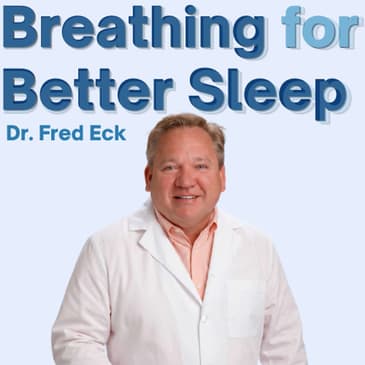
Welcome back to Breathing for Better Sleep. I’m Dr. Fred Eck, and today we’re delving into a fascinating, often misunderstood topic within the world of sleep and health- craniosacral therapy. Many people think of sleep issues like snoring, sleep apnea, and airway problems as purely medical, but there’s a growing awareness that the structures of our skull and nervous system play a critical role as well.
Joining me is Dr. James Cima, a seasoned expert in cranial structural dynamics and author of Achieving Unlimited Health. Together, we explore how the movement of cranial bones, flow of cerebrospinal fluid, and balance of the autonomic nervous system can influence sleep quality and even broader aspects of health like TMJ, headaches, and sinus issues. Whether you’re a patient struggling with insomnia or a healthcare provider curious about integrating new therapeutic approaches, this episode will shed light on the pivotal connections between structure, breathing, and deep restorative sleep. Stay tuned for an enlightening conversation that might just reshape how you think about sleep and overall well-being.
00:00 Discovering Cranial Work's Importance
03:54 Getting involved with TMJ work
08:21 Cerebral spinal fluid explained
10:58 Balancing the nervous systems
14:18 Understanding Insomnia and Misdiagnosis
19:02 The importance of proper breathing
20:26 Addressing sleep apnea challenges
25:26 Impact of TMJ work on balance
27:45 Cranial sacral therapy benefits
32:03 Cranial sacral therapy explained
35:42 Patient recovery timeline and advice
38:11 Addressing early disease detection
Unlocking Better Sleep: How Craniosacral Therapy Connects Structure, Breathing, and Rest
Sleep isn’t just about counting sheep or finding the right mattress—it’s also about understanding the deep connections between our body’s structure, our nervous system, and how we breathe. On the latest episode of “Breathing for Better Sleep,” Dr. Fred Eck sat down with Dr. James Cima, a leading expert in cranial structural dynamics, to explore how craniosacral therapy could hold answers for patients struggling with insomnia, sleep apnea, jaw pain, and much more.
Here are the key insights from their conversation:
Beyond Traditional Sleep Medicine: Why Structure Matters
Many people think of the cranium (your skull) as a solid, immovable shell. But as Dr. Seema points out, that’s a myth. The skull consists of multiple bones connected by sutures that are not fully fused, even in adulthood. In fact, subtle cranial movements support the flow of cerebral spinal fluid (CSF)—a crucial element for neurological and overall health.
Craniosacral therapy targets these subtle motions. “[CSF] constantly produces and flows from the brain, out into the spinal cord and nerves, and is reinvested into the lymphatic system,” explained Dr. Seema. “Without cranial motion, CSF can’t flow… It’s just an impossibility”.
The Autonomic Nervous System: The Sleep-Stress Tug of War
Good sleep depends on our ability to shift from “fight or flight” (sympathetic mode) to “rest and digest” (parasympathetic mode). Modern life—with its constant notifications, loud media, and late-night stress—often keeps us “chased by the lion” even at night.
Dr. Seema emphasized the vagus nerve’s role, which emerges from the base of the skull and is closely connected to our autonomic nervous system 11:11. If cranial motion is restricted, it can affect the vagus nerve and tip the nervous system out of balance—leaving us tense, restless, and unable to get restorative sleep.
Breathing—Slower, Not More
Both doctors noted that most people breathe inefficiently. Modern stress causes us to take quick, shallow breaths, which upsets the balance in our bodies and can keep us wired at bedtime.
Surprisingly, the key isn’t to take more breaths, but fewer and slower ones. As Dr. Eck put it, “to breathe better, we have to breathe less. Slow it down.” Dr. Cima recommends inhaling for a count of five, exhaling for ten—a practice that instantly calms the nervous system and prepares the body for sleep.
Structural Tension and Sleep Quality
Do you toss and turn, unable to get comfortable? Structural tension in the head, neck, jaw, and chest can block relaxation—and optimal breathing. “If you can break a lot of the fixations in the neck, shoulders, upper thoracic spine… people just want to go to sleep afterward,” Dr. Cima said 16:10.
He also discussed how misalignments in the jaw (TMJ), bite, or cranial bones can lead to headaches, sinus congestion, vertigo, and even ear infections—especially in children 24:05. All of these issues feed back into sleep quality, creating a vicious cycle.
How Craniosacral Therapy Fits In
Craniosacral work isn’t just for pain or injury—it can play a central role in treating the root causes of breathing-related sleep disorders. “If you have any kind of craniosacral problem—which you have to have, the longer you’re on this planet… things get progressively worse.” Addressing these imbalances can help prevent problems like early-onset dementia, chronic congestion, and persistent sleep issues.
A typical craniosacral evaluation involves a detailed history, structural exam, and gentle hands-on techniques to restore motion and release tension. Most people begin to see meaningful improvements within four to six weeks.
Multidisciplinary, Individualized Care
Both Dr. Eck and Dr. Cima agree: sleep-related breathing issues rarely have a single cause or cure. Success comes from a team effort—combining dental, cranial, medical, and behavioral expertise. And for patients, participation and follow-through are essential to lasting results 37:40.
Key Takeaway
If you or a loved one struggles with poor sleep, don’t ignore the wider picture. Consider how structure, breathing, and the nervous system work together—and know that therapies like craniosacral work could make a profound difference. To learn more, visit sleeptmentdirect.com and explore a truly integrative approach to breathing and better sleep.
Podcast Website - https://breathingforbettersleep.com/
Dr. Fred Eck - Website - https://sleeptreatmentdirect.com/dr-fred-eck/
Podcast Media Partner: TopHealth - https://www.tophealth.care/
“Disclaimer: Informational only. Not medical advice. Consult your doctor for guidance.”